
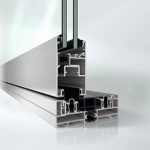
In a high-performance aluminum window, glass typically accounts for the majority of the unit's total area — and therefore the majority of its heat loss. Choosing the wrong glazing build-up can undo the benefit of a premium thermal break profile. This guide explains the four levers that define glazing performance.
Lever 1: Number of Panes
Each additional pane adds an insulating cavity. The performance gain is not simply additive: the second pane delivers the largest jump, and each subsequent pane adds progressively less.
- Single glazing — historic and temporary applications only; not acceptable for modern energy codes.
- Double glazing — the practical baseline for most residential and commercial projects.
- Triple glazing — required where Passive House or near-Passive targets apply, and increasingly standard in cold climates.
Triple glazing also adds weight, which directly affects sash size limits and hardware selection — a factor often overlooked during early design.
Lever 2: Low-E Coatings
A microscopically thin metallic oxide coating on a glass surface reflects long-wave infrared radiation back into the room. Position matters:
| Surface | Effect | When to use |
|---|---|---|
| Inner-facing surface of the outer pane | Retains heat in the building — low U-value | Heating-dominated climates, most specifications |
| Outer-facing surface of the inner pane | Blocks solar heat gain — low SHGC | Cooling-dominated climates, large glazed elevations |
| Multiple coatings | Balances U-value and solar control | Projects with both heating and cooling loads |
Specify the coating position explicitly. It is one of the most common sources of performance mismatch between specification and delivered product.
Lever 3: Cavity Gas
Air is a decent insulator; heavier, less mobile gases are better. Filling the cavity with argon or krypton suppresses convection and improves the U-value without changing the visual appearance of the window. Argon is the standard choice for cost-effectiveness; krypton suits narrower cavities where a slim sightline is required.
Lever 4: Spacer Technology
The spacer separates the panes around the perimeter. Conventional aluminum spacers are thermally conductive and act as a cold bridge, causing condensation at the glass edge. Warm-edge spacers (stainless steel, hybrid or plastic composite) reduce this effect, improving the glazing U-value and eliminating perimeter condensation in most conditions.
Putting It Together
A typical high-performance build-up for a premium aluminum system:
- Triple glazing, 6 / 16 / 6 / 16 / 6 construction
- Double Low-E coating tuned to the project's heating/cooling balance
- Argon fill in both cavities
- Warm-edge spacer
- Combined with a multi-chamber thermal break profile
The overall result is reported as Uw. Always reconcile Uw against the values stated in the code or certification scheme governing the project.
Specification Checklist
- Required Uw target, and whether Passive House certification is needed
- Required SHGC / g-value for solar control
- Required acoustic rating — asymmetric build-ups can help
- Safety and security glass requirements (laminated, toughened, anti-burglary films)
- Weight budget — confirm against sash and hardware limits
- Spacer type — specify warm-edge explicitly
Glazing Advice from the Factory Floor
Because we fabricate rather than simply resell, we can test and confirm glazing combinations against the actual profile geometry. Shanghai Ruishi Window & Door has produced high-end aluminum window, door and curtain wall systems for more than 20 years using German imported machinery, and supplies certified Schüco systems across luxury villas, commercial buildings and industrial facilities.
Send us your project's U-value, solar control and acoustic targets and we will return a glazing specification matched to the correct HOPPE system — including spacer, coating position, gas fill and glass thicknesses — with the corresponding Uw calculation.